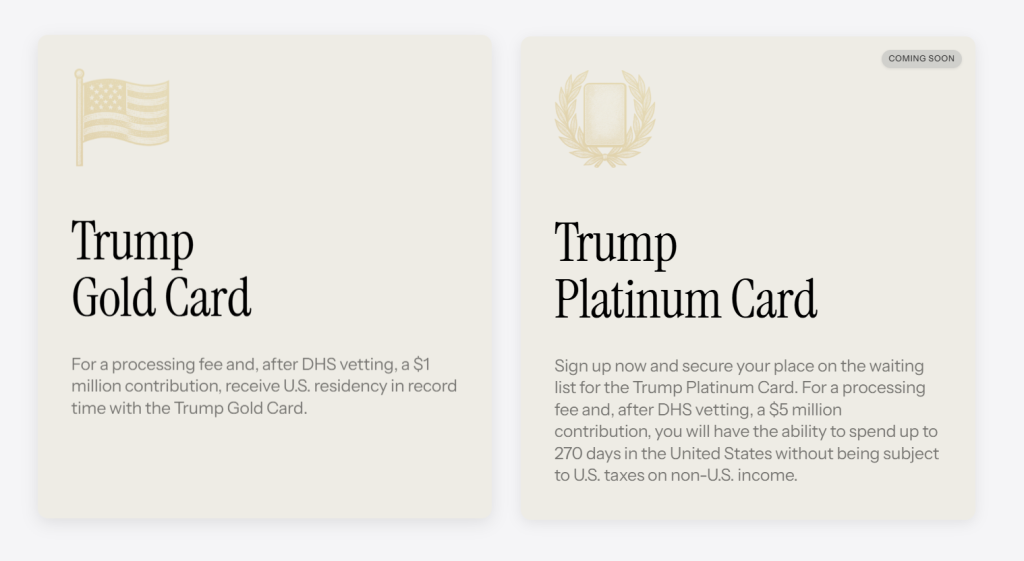
President Donald Trump launched a three-tier visa program on Friday that requires $1 million payments for permanent US residency, introduces $2 million corporate cards with employee transferability, and announces $5 million platinum cards for extended stays without foreign income taxation.
The Gold Card program replaces Trump’s original February proposal for a single $5 million card, instead creating separate tracks for individuals, corporations, and wealthy visitors. The administration has mandated implementation within 90 days across three federal departments.
Trump positioned the initiative as a deficit reduction tool during the Oval Office signing ceremony. “They’re going to spend a lot of money to come in,” he told reporters. “It’s going to raise billions of dollars, billions and billions of dollars, which is going to go to reduce taxes, pay off debt, and for other good things.”
Platinum Card Creates a Tax-Advantaged Class
The $5 million Platinum Card, pending congressional approval, allows holders to “spend up to 270 days in the United States without paying U.S. taxes on non-U.S. income.”
This structure allows wealthy individuals to remain outside traditional tax residency parameters while providing nearly nine months of annual US access.

Gold Card holders are subject to taxation “similarly to other permanent residents and citizens,” while Platinum Card recipients retain their foreign tax status despite spending extensive time in the US.
The official website warns prospective Platinum Card applicants to “join the waitlist now, as officials will process them on a first-come, first-served basis.” This messaging suggests the administration anticipates substantial demand despite the unprecedented pricing.
The New Corporate Gold Cards
The Trump Corporate Gold Card is one of the new tiers under Trump’s new donation-based immigration vision. It requires $2 million per employee while creating transferable corporate immigration assets.
Companies can “cease sponsoring one employee and use the gift contribution tied to the prior application as a basis for sponsoring a new employee without a new $2 million gift.”
This transferability mechanism transforms immigration sponsorship into renewable corporate resources. Companies pay initial fees plus “a small annual maintenance fee and a transfer fee” to maintain and reallocate sponsored positions indefinitely. The Department of Homeland Security vets each transfer.
The corporate structure suggests the administration expects major employers to purchase multiple cards, treating immigration slots as business assets rather than individual employee benefits. This approach creates perpetual revenue streams while allowing companies unprecedented flexibility in managing sponsored workers.
Gold Card May Replace Standard immigration Routes
Commerce Secretary Howard Lutnick announced that traditional immigration pathways will soon cease operation. “In less than a month, the other visa Green Card categories are likely to be suspended, and this will be the model that people can come into the country,” he stated during the announcement.
The official website trumpcard.gov confirms that Gold Card holders receive “lawful permanent resident status as an EB-1 or EB-2 visa holder.”
These categories historically served individuals with extraordinary abilities or advanced degrees, but now require $1 million payments to the Commerce Department plus a $15,000 vetting fee.
The program demands that applicants demonstrate they “will substantially benefit the United States” through their financial contribution. Lutnick defended this approach, arguing that “you can prove exceptional value for the United States of America by contributing $1 million to the United States of America.”
Timeline and Demand
Trump’s executive order compels the Commerce, State, and Homeland Security departments to establish the program within 90 days. This timeline encompasses developing application processes, setting fees, implementing vetting procedures, and determining launch dates.
The program initially makes 80,000 Gold Cards available, according to Lutnick, who described the current phase as implementation. This allocation exceeds typical annual EB-1 and EB-2 issuance combined, suggesting substantial expansion of wealth-based immigration.

Early registration data indicate international interest. When the administration opened waiting lists in June, nearly 69,000 people registered within days despite the program existing only as a policy proposal.
The administration frames payments as “gifts” to the Commerce Department rather than fees, potentially circumventing legal restrictions on visa pricing. This semantic distinction may prove crucial if courts examine the program’s legality.
The $15,000 vetting fee represents a substantial increase over standard immigration processing costs.
Parallel H-1B Changes
Trump simultaneously imposed a $100,000 annual fee on H-1B visas, creating contrasting treatment for wealthy investors and skilled workers. This dual approach channels immigration through economic rather than merit-based criteria.
The H-1B fee increase targets technology companies and consulting firms that rely heavily on foreign workers. Trump suggested technology executives would welcome the Gold Card program as an alternative pathway for employee immigration.
Revenue Projections
Lutnick projected the program will generate over $100 billion in government revenue, though this requires selling 100,000 Gold Cards or 20,000 Platinum Cards. These projections assume sustained demand at pricing levels without precedent in global immigration markets.
Process Details and Qualification Criteria
The website outlines a three-step process beginning with application submission and nonrefundable processing fees. The United States Citizenship and Immigration Services then “facilitates an in-depth background check and process to vet the potential cardholder” before final approval.
The program requires that applicants be “eligible for lawful permanent resident status, admissible to the United States, and a visa must be available.” These standard immigration requirements remain despite the financial pathway.
Officials emphasize that the “Trump Gold Card is a visa; therefore, national security and other risks are a basis for revocation.” This language preserves government authority to cancel cards for security reasons despite their high cost.